Last updated
Traffic Violations Check Saudi Arabia: What to Do the Day You Get an SMS Fine
A traffic violations check in Saudi Arabia takes two minutes: log in to Absher and open Query Traffic Violations, or view all your government fines on the Efaa platform. From the day you are notified, you have 30 days to object and then 15 days to pay, with the option to request up to 90 extra days. Ignore it and your bank balance can be seized.
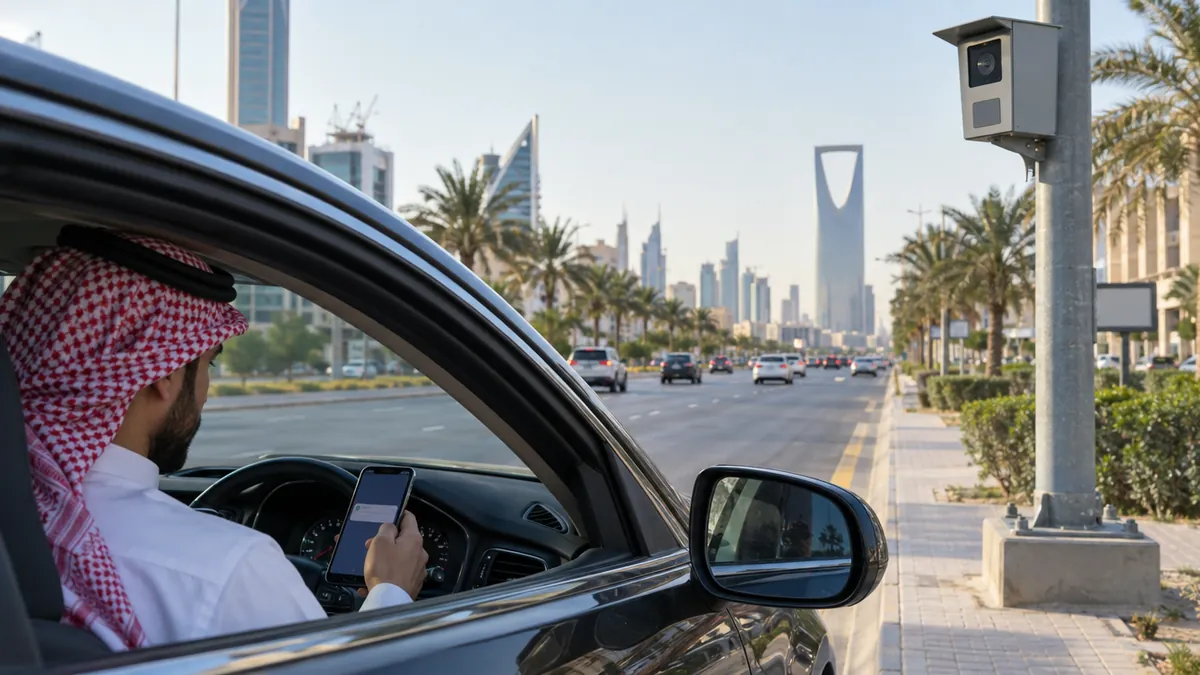
Most people find out about a fine the same way: an SMS arrives while they are at work. This guide is written for that moment. We go through what to do in the first hour, how to check and pay, how the deadlines and the 25% reduction work, when an objection makes sense, and why an unpaid fine can follow you to the airport.
The first hour: a calm plan for the SMS fine
An SMS about a violation is a notice, not a demand to pay through a link. Treat it as a prompt to check the official record yourself.
- Do not tap any payment link in a message. Fake "unpaid fine" texts are a common scam across the Gulf. Go to Absher or Efaa by typing the address yourself, or use the official app.
- Log in to Absher Individuals and open the traffic services. Choose Query Traffic Violations.
- Match the details. Check the violation number, date, time, location and plate. Is the car yours, or one registered to you that someone else drives?
- Note the notification date. Your 30-day objection window runs from when you were notified. Write the date down. If a notice shows only a Hijri date, our Hijri date converter will give you the Gregorian one.
- Decide: pay, object or ask for time. If the fine is correct, paying early is usually cheapest. If it is wrong, object inside the 30 days. If money is tight, plan an extension request.
- Look at the whole record, not just the new fine. Older unpaid fines are what usually cause trouble later.
Where to check traffic fines: Absher, Efaa and your bank
All three show the same underlying violation records, but each is better for a different job.
| Channel | Best for | What you need |
|---|---|---|
| Absher Individuals: Query Traffic Violations | Seeing traffic fines, disputing them and requesting more time to pay | Absher account linked to your iqama |
| Absher: Query Traffic Violations for Visitors | Visitors without an iqama | Border number |
| Efaa (efaa.sa), the National Violations Platform | One view of violations from about 36 government bodies, not only traffic | Individual login with your iqama details |
| SADAD in your bank app | Paying quickly once you have checked the fine | Your iqama number |
Efaa is run by the National Information Center under SDAIA, the Saudi Data and AI Authority. It is useful because a municipal or other government fine will not appear under traffic services on Absher, but it will appear on Efaa.
Why do I see a fine for a car I was not driving?
A camera records the vehicle, not the face behind the wheel, so the violation usually lands on the record of the person the car is registered to. If you lent your car, expect the fine to show under your iqama. Settle it with the driver privately, and if you no longer want someone driving your car, Absher has a Cancel Vehicle Driving Authorization service.
Traffic fine deadlines and the 25% reduction
The deadlines come from Article 75 of the Traffic Law, which we read on the Bureau of Experts site. They apply to residents and citizens alike.
| Stage | Time limit | What the law says |
|---|---|---|
| Objection | 30 days from notification | You may object before the competent court; a later objection is heard only with an excuse the court accepts |
| Payment | 15 days after the objection period ends (or after a rejection or court ruling) | The fine must be paid |
| Extension | Request within those 15 days | Extra time of up to 90 days to pay |
| Instalments | Single violation | The fine for one violation may be paid in parts |
| Reduction | Set by ministerial rules | Up to 25% off the minimum fine |
| Non-payment | After the set period | Direct seizure and enforcement against bank account balances is allowed |
To ask for more time, use the Absher service called Extending the Deadline for Paying Traffic Violations. The request has to go in during the 15-day payment window, not after it closes.
How does the 25% traffic fine discount work?
The law allows a reduction of up to 25% of the minimum fine, under rules set by the Minister of Interior with the Minister of Finance. The traffic department said in 2024 that this applies to violations recorded from 18 April 2024 and that some serious violations, such as drifting, are excluded. The reduction is tied to paying within the deadlines, so treat the amount shown on Absher or in SADAD at payment time as the real figure, and expect to lose the reduction if you let the deadlines pass.
How to pay a traffic fine
Once you have checked the violation and you agree with it, payment is quick.
- Open your bank app and go to bill or government payments (SADAD).
- Choose the Ministry of Interior traffic violations option.
- Enter your iqama number to load the unpaid fines.
- Select the violations you want to pay. Check that each amount matches what you saw on Absher.
- Confirm the payment and keep the receipt.
- Check Absher again a little later to confirm the violation has cleared.
Efaa can also be used to view and pay violations. Whichever route you use, do not pay through a link sent by text or WhatsApp.
How to object to a traffic violation
Objecting only makes sense when you have a real reason: the plate was misread, the car had been sold, the vehicle was stolen at the time, or the details do not match the place or time. Disagreeing with the speed limit is not a reason.
- In Absher Individuals, open the traffic services and choose Dispute Traffic Violations.
- Select the violation you want to dispute.
- Write a short, factual reason. Mention dates and any document that supports you, such as a sale record or police report.
- Submit and save the request number.
- Follow the result in Absher. If the objection is rejected, the 15-day payment window starts.
You can also take your objection to the traffic committee at a traffic office. Either way, the clock matters: the law gives 30 days from notification.
Do fines block your exit re-entry visa, bank account or licence?
A traffic fine can feel like a small cost you deal with later. The law and the systems behind it say otherwise.
- Travel: clearing traffic violations has repeatedly been listed among the conditions for issuing an exit re-entry or final exit visa to a resident. Check your record before you book flights. See our guides to the exit re-entry visa and the final exit visa.
- Bank account: Article 75 allows direct seizure of your bank balances when fines stay unpaid after the deadline. If your account is suddenly restricted, read what to do when your Saudi bank account is frozen.
- Licence points: Article 76 gives each violation a number of points, and your licence is withdrawn once you pass the maximum. More on licences in our Saudi driving licence guide.
The safest routine is boring but effective: check Absher once a month, pay correct fines inside the window, object quickly to wrong ones, and keep your vehicle insurance and registration valid so one problem does not stack on another.
Frequently asked questions
How do I check my traffic violations in Saudi Arabia?
Log in to Absher Individuals with your iqama number and use the Query Traffic Violations service in the traffic section. It shows each violation, its number, date and amount. You can also see violations from traffic and other government bodies on Efaa, the National Violations Platform at efaa.sa. Visitors without an iqama can use the Query Traffic Violations for Visitors service on Absher with their border number.
How long do I have to pay a traffic fine in Saudi Arabia?
Under Article 75 of the Traffic Law, you have 30 days from being notified to object. If you do not object, or your objection is rejected, you must pay within 15 days. During those 15 days you can ask for extra time of up to 90 days. Absher has a service called Extending the Deadline for Paying Traffic Violations for this request.
Is the 50 percent traffic fine discount still available?
No. The 50 percent reduction covered violations recorded before 18 April 2024. It ran for six months, was extended for another six months, and the Ministry of Interior announced its end in April 2025. Fines that were not paid in that window went back to their original value. What remains is the separate rule in Article 75 allowing a reduction of up to 25 percent of the minimum fine.
Can I object to a traffic violation online?
Yes. Absher has a Dispute Traffic Violations service where you select the violation and explain why you think it is wrong. The Traffic Law gives you 30 days from being notified of the violation to object, and a court may accept a later objection only if you give an excuse it accepts. Objections can also be raised in person with the traffic committee at a traffic office.
What happens if I do not pay my traffic fines?
Article 75 of the Traffic Law says that if you do not pay within the set period, the authorities may seize and enforce directly against your bank account balances, under a mechanism agreed between the Ministry of Interior, the Ministry of Justice, the Ministry of Finance, the Saudi Central Bank and the Board of Grievances. Unpaid fines also commonly hold up government services such as visa and vehicle transactions.
Do unpaid traffic fines stop an exit re-entry visa?
They can. Settling traffic violations has repeatedly been listed among the conditions for issuing an exit re-entry or final exit visa to a resident, and unpaid fines are one of the most common reasons a visa request stalls on Absher. Check your violations and clear them before you book a flight, so a small fine does not delay your trip home.
General information only, not legal advice. We are not affiliated with any Saudi government authority.