Last updated
Riyadh Metro Guide for Commuters: Lines, Tickets, Hours and Getting to KAFD and the Airport
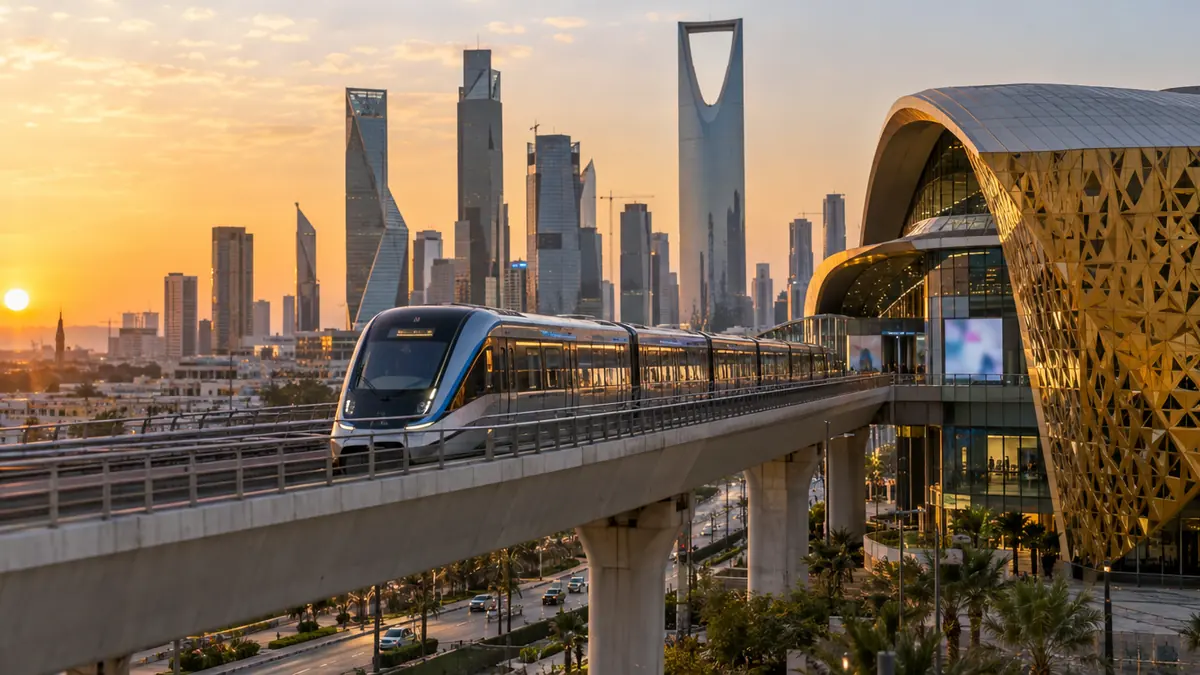
The Riyadh Metro is a six-line, 85-station driverless network that links the city centre, Olaya, KAFD and King Khalid International Airport. A standard ticket costs SAR 4 and covers unlimited metro and bus rides for 2 hours, and passes run from 3 to 30 days. You pay with the Darb app, a Darb card or a contactless bank card.
This guide is written for people who want to use the metro to get to work, not just ride it once. We cover which line you need, how to choose between a single ticket and a pass, first class versus standard, the hours, the rules that catch newcomers, park and ride, and two common commutes: into KAFD and out to the airport.
The six lines and their colours
Every line has a number and a colour, and the trains themselves are painted in their line colour, so you can confirm you are on the right platform at a glance. The full network is 176 km long. The Blue, Yellow and Purple lines opened on 1 December 2024, the Red and Green lines on 15 December 2024, and the Orange Line on 5 January 2025, which completed the system.
| Line | Main corridor | Length | Useful for |
|---|---|---|---|
| Line 1 Blue | Olaya, Al-Batha, Al-Hayer | 38 km | Olaya offices, the old centre, KAFD |
| Line 2 Red | King Abdullah Road | 25.3 km | King Saud University, King Fahd Sports City |
| Line 3 Orange | Al-Madinah Al-Munawarah Road, Prince Saad bin Abdulrahman I Road | 40.7 km | East to west across the city, Jeddah Road |
| Line 4 Yellow | King Khalid International Airport Road | 29.5 km | KAFD to the airport terminals |
| Line 5 Green | King Abdulaziz Road | 12.9 km | Ministries area, National Museum |
| Line 6 Purple | Abdulrahman bin Awf Road, Sheikh Hassan bin Hussain bin Ali Road | 29.7 km | KAFD to the eastern districts |
RCRC names four main hub stations where several lines and bus routes meet: Qasr Al-Hukm, KAFD, the Western Station and STC (Al-Olaya). The Western Station on the Orange Line started operating in May 2026. Work is also under way on an 8.4 km Red Line extension from King Saud University to Diriyah with five new stations, so the map will grow.
Which line is the busiest?
The Blue Line along Olaya is the busiest by far. Riyadh's transport authority said in 2025 that it carried nearly half of all journeys, followed by the Red Line on King Abdullah Road and the Orange Line on Madinah Road. If you board in Olaya at rush hour, expect full trains and let one pass if needed.
Riyadh Metro tickets and passes: what to buy
All tickets are time-based, not distance-based. You pay for a period, and during that period you can ride as many trains and Riyadh Bus routes as you like. The two-hour ticket starts from your first check-in. Here are the prices published by King Khalid International Airport and RCRC.
| Validity | Standard | First class |
|---|---|---|
| 2 hours | SAR 4 | SAR 10 |
| 3 days | SAR 20 | SAR 50 |
| 7 days | SAR 40 | SAR 100 |
| 30 days | SAR 140 | SAR 350 |
| 1 year (since 1 Jan 2026) | SAR 1,260 | SAR 3,150 |
| Student semester, 4 months (since 1 Jan 2026) | SAR 260 | Not offered |
The annual pass and the student semester ticket went on sale on 1 January 2026, Gulf News reported. The student ticket is standard class only and lasts four months. Children under six ride free with a paying adult. RCRC also lists a 50 percent discount for eligible groups such as seniors, students, cancer patients and families of martyrs.
Is the 30-day pass worth it for a daily commuter?
Usually, yes. Two standard tickets a day cost SAR 8. Over 22 working days that is SAR 176, against SAR 140 for the 30-day pass, and the pass also covers weekend trips and buses. If you work from home two or more days a week, do the sum again: at 15 commuting days, single tickets cost SAR 120 and come out cheaper.
If you know you will commute all year, the annual pass saves more. Twelve standard 30-day passes cost SAR 1,680, against SAR 1,260 for the standard annual pass, a saving of SAR 420.
How do I pay at the gate?
You have four options. Each one ends with a tap at the gate.
- Darb app: download the official Darb app (App Store listing), buy a 2-hour, 3-day, 7-day or 30-day product, then activate the digital card and tap your phone.
- Darb card: buy a physical card at any ticket vending machine or station ticket office, then load a ticket or pass on it.
- Contactless bank card: tap a contactless debit or credit card directly at the gate.
- Phone wallet: Apple Pay in Express Mode works at the gate even while the phone is locked.
First class or standard?
There are two fare classes. A first class ticket gives you unlimited rides in the first class cabins of the metro plus regular buses. A standard ticket covers the regular metro cabins and buses. Glass partitions separate the sections of each train, and the regular cabins include dedicated women-only areas, so check the floor and door signs as you board.
For a short hop, standard is fine. First class makes sense if you ride the crowded Blue Line at peak time every day and want a seat, or if you carry a laptop bag and need space. Remember the price gap grows with the pass: SAR 350 against SAR 140 a month.
Hours, rules and what people get wrong
Trains run from early morning until around midnight. The airport operator lists the hours as 6:00 AM to midnight, and the transport authority announced in September 2025 that service would start at 5:30 AM every day. Friday mornings, Ramadan and the Eid holidays use their own timetables, which are announced in the Darb app and on the Riyadh public transport accounts on X. If you have an early flight or a Friday shift, check that day's timetable rather than assuming the weekday one.
Basic rules are what you would expect on any modern metro. Hold a valid ticket for the class you sit in, keep your card or phone with you until you leave, give priority seats to elderly and disabled passengers, and respect the women-only areas. Do not touch emergency handles unless there is a real emergency. In December 2024 tampering with an emergency switch halted part of the Blue Line, so this is taken seriously.
Myth: the Darb app and Darb Al Watan are the same thing
They are not. Darb is the Riyadh public transport app and card used for the metro and Riyadh Bus inside the city. Darb Al Watan is a separate intercity coach brand for trips between cities. Searching app stores for "Darb" often shows both, so check that the app you install mentions Riyadh Metro and Riyadh Bus.
Myth: you need a new ticket when you change lines or take a bus
You do not. Every ticket covers unlimited metro rides and Riyadh Bus rides for its full validity. A SAR 4 ticket lets you ride the Purple Line, change to the Yellow Line at KAFD, then catch a feeder bus, as long as you finish within 2 hours of your first check-in.
Commuter routes: KAFD, the airport and park and ride
How do I get to KAFD by metro?
KAFD station is where the Blue, Yellow and Purple lines meet, next to King Fahd Road near the Northern Ring Road. From Olaya or the city centre, take the Blue Line north. From the eastern districts, take the Purple Line. From the airport side, take the Yellow Line. The station is one of the four main hubs and has public transport parking and ticket offices.
How do I get to King Khalid International Airport?
Normally you take the Yellow Line (Line 4), which runs from KAFD along the airport road. The airport has three metro stations, so get off at the right one:
- Terminal 1 and 2 station: near the arrivals area of Terminals 1 and 2.
- Terminal 3 and 4 station: near the arrivals and departures areas of Terminals 3 and 4.
- Terminal 5 station: at the main entrance of Terminal 5, which normally handles domestic flights.
Temporary change: since the airport reopened on 25 October 2026, domestic flights use Terminal 1 and international flights by Saudi carriers use Terminal 2. Terminals 3, 4 and 5 are closed until further notice, and many foreign airlines have not yet resumed. Check which terminal your airline uses before you leave home. The trip time depends on where you join the line, so use the journey planner in the Darb app. If someone is meeting you, the airport has a designated pick-up area about two minutes' walk from the arrivals hall.
Can I drive to a station and park?
Yes. RCRC says there are 19 park and ride sites for metro passengers, each with space for about 400 to 600 cars, and four more parking sites for bus passengers connecting to the metro. This suits people who live in outer districts without a station nearby: drive the short leg, park, and avoid the worst of the Olaya and King Fahd Road traffic. The Darb app shows parking locations. If you are still deciding whether to buy a car at all, compare a 30-day pass with fuel, parking and insurance using our petrol price guide and the cost of living breakdown.
A simple first-week plan for new commuters
- Install the official Darb app and register.
- Plan your home-to-office route in the app, and note the station where you change lines.
- Ride your route once outside rush hour with a SAR 4 ticket to learn the platforms and exits.
- Count how many days a month you will actually commute, then decide between single tickets, a 30-day pass and the annual pass.
- Turn on service alerts so you hear about Friday, Ramadan or holiday timetable changes early.
Once you have the route in your head, the metro is often the quickest way across central Riyadh at peak hours, and it is far more predictable than the roads. For longer trips beyond the capital, see our guide to the Haramain train.
Frequently asked questions
How much is a Riyadh Metro ticket?
A standard Riyadh Metro ticket costs SAR 4 and is valid for 2 hours from your first check-in, with unlimited metro and Riyadh Bus rides in that window. Standard passes cost SAR 20 for 3 days, SAR 40 for 7 days and SAR 140 for 30 days. First class costs SAR 10 for 2 hours, SAR 50 for 3 days, SAR 100 for 7 days and SAR 350 for 30 days. Since 1 January 2026 there is also an annual pass (SAR 1,260 standard, SAR 3,150 first class) and a SAR 260 student semester ticket. Children under six travel free with a paying adult.
What are the Riyadh Metro timings?
Trains run from early morning until around midnight. King Khalid International Airport lists the metro hours as 6:00 AM to 12:00 midnight, and the transport authority moved the daily opening to 5:30 AM in September 2025. Friday mornings, Ramadan and Eid holidays have their own timetables, so check the Darb app or the Riyadh public transport accounts on X before an early or late trip.
Can I pay for the Riyadh Metro with my bank card?
Yes. Besides the Darb card and the Darb app, the gates accept contactless bank cards and phone wallets such as Apple Pay in Express Mode. You simply tap at the gate. If you ride every working day, a pass bought in the Darb app usually works out cheaper than paying per trip, and it also covers Riyadh Bus rides during its validity.
Which Riyadh Metro line goes to the airport?
The Yellow Line (Line 4) runs along King Khalid International Airport Road from KAFD to the airport, which has three metro stations: Terminal 1 and 2, Terminal 3 and 4, and Terminal 5. From the Blue or Purple lines, change at KAFD. Service to the airport stations was suspended after the 10 October 2026 attack on the airport, which reopened only Terminals 1 and 2 on 25 October, so check the Darb app before you travel.
Is there parking at Riyadh Metro stations?
Yes. The Royal Commission for Riyadh City says the network has 19 park and ride sites for metro passengers, each holding about 400 to 600 cars, plus four more for bus users. The main hub stations, including KAFD, Qasr Al-Hukm, STC and the Western Station, also have public transport parking. The Darb app has a feature for locating parking areas.
Who gets a discount on the Riyadh Metro?
The Royal Commission for Riyadh City lists a 50 percent discount for eligible groups, including seniors, students, cancer patients and families of martyrs. Children up to six years old travel free when accompanied by a fare-paying adult. Eligibility is checked through the official ticketing system, so apply for the discounted product in the Darb app or at a station ticket office.
General information only, not legal advice. We are not affiliated with any Saudi government authority.