Last updated
Carrying Medication to Saudi Arabia: What Is Allowed, What Needs SFDA Approval and What Is Banned
- SFDA: Conditions and requirements for clearance of drugs and pharmaceuticals for individuals for personal use (v3.0, 26 Oct 2025)
- SFDA: Regulations for clearance of medicines and medical supplies arriving for pilgrims (Hajj 1446 edition)
- SFDA: pilgrims carrying narcotic or psychotropic medicines must apply via CDS (5 May 2026)
- SFDA: launch of the Traveler Permit for Controlled Drugs (12 Feb 2025)
Carrying medication to Saudi Arabia is allowed for personal use if the medicine is in its original packaging, in date, and backed by a prescription or medical report under six months old. The SFDA allows up to three months of ordinary medicines (one month for Hajj and Umrah pilgrims), while narcotic and psychotropic medicines need prior approval through its Controlled Drugs System and are capped at 30 days.
Two SFDA documents govern this. The first is the conditions for clearing drugs, pharmaceuticals and cosmetics for individuals for personal use (version 3.0, dated 26 October 2025), which applies to every traveller and to parcels. The second is the pilgrim requirements issued for each Hajj season, which set tighter quantities for people arriving on Hajj and Umrah visas. Below is the traffic-light version of those rules, then the detail on quantities, paperwork, the controlled-drugs permit, insulin and injections, and what pilgrims must do differently.
The traffic-light table: allowed, needs approval, banned
| Status | Medicine or product | Limit | What you must carry |
|---|---|---|---|
| Green: allowed | Over-the-counter medicines, vitamins, registered herbal products, dietary supplements | Up to 3 months of use as stated on the directions (1 month or length of stay for pilgrims) | Original packaging, within expiry |
| Green: allowed | Prescription medicines that are not controlled: blood pressure, diabetes tablets, insulin, inhalers, thyroid, cholesterol, most antibiotics | Up to 3 months per the prescription (1 month or length of stay for pilgrims); no repeat request in that period | Prescription or medical report, approved by the treating institution, no older than 6 months, showing diagnosis, medicine, dose and duration |
| Green: allowed | Medical devices and supplies: needles, pen tips, glucose strips, nebuliser, CPAP consumables | 1 month of use or length of stay (pilgrim rules) | Medical report or prescription showing the need, no older than 6 months; original packaging |
| Amber: approval first | Medicines containing narcotic drugs or psychotropic substances: opioid painkillers, benzodiazepines, ADHD stimulants and similar | 30-day supply or length of stay, whichever is shorter; SFDA may make an exception if the drug and its alternatives are unavailable locally | SFDA approval issued through the Controlled Drugs System (CDS) before travel, plus the prescription or report |
| Amber: check first | Medicines controlled locally in Saudi Arabia but not narcotic | 3 months or length of stay, whichever is shorter | Prescription; if you are unsure which group your medicine is in, ask the SFDA on 19999 before you fly |
| Red: banned | Substances in Category D of Schedule One and Category A of Schedule Two of the Anti-Narcotics Law, and paragraph Fourth of its schedules | No clearance possible | Do not travel with them |
| Red: banned | Products with misleading or unproven medical claims (weight loss, weight gain, whitening) or sexual claims; herbal mixtures of unknown composition or source | Refused | Also on the ZATCA prohibited list when not SFDA-registered |
| Red: banned | Blood derivatives and vaccines; medicines that must be used under medical supervision; radioactive materials | Refused | Hospital-administered products travel through licensed channels only |
| Red: banned | Expired medicines; loose tablets or medicines without original packaging; packs dispensed by a hospital pharmacy without labels | Refused | Repack nothing; keep the pharmacy box and label |
| Red: banned | Quantities beyond your documented need | Excess refused and handed to ZATCA for destruction | Match the quantity to the prescription and your stay |
ZATCA's own prohibited list for travellers adds "pills, intoxicants, and drugs of all kinds", unregistered "pills, creams, sexual tonics, abortion pills, herbs, and lotions", and "nutmeg fruit and its powder". The two lists overlap but are kept by different authorities, so a product can pass the SFDA test and still be stopped by customs if it is not registered in the Kingdom.
Quantity limits: three months, one month, or 30 days?
This is where most confusion starts, because three different numbers are correct in three different situations.
| Who you are | Non-controlled medicines | Narcotic or psychotropic medicines | Source |
|---|---|---|---|
| Resident or visitor arriving on any visa other than Hajj or Umrah | Up to 3 months of use per the prescription or directions; no repeat within the period | 30 days or length of stay, with CDS approval | SFDA personal-use conditions v3.0, item 1.10 |
| Hajj or Umrah pilgrim | 1 month of use or length of stay, whichever is less | 30 days or length of stay, with CDS approval; expiry must be valid | SFDA pilgrim requirements, Section Three |
| Anyone, medical devices and supplies | 1 month of use or length of stay (pilgrim rules); report required | SFDA pilgrim requirements, Section Three | |
| Anyone, by courier or post | Via the Faseh platform with invoice and waybill, same 3-month cap | Not allowed by courier or post at all | SFDA personal-use conditions, items 1.6 to 1.8 |
The paperwork: prescription or medical report
For non-controlled medicines, the SFDA asks for a copy of the prescription or a medical report that states the diagnosis and the medicine required, the duration of treatment and the recommended dose, approved by the treating institution and issued within the last six months. For narcotic and psychotropic medicines the pilgrim requirements spell out more: a detailed report with the patient's personal information, diagnosis, treatment plan and duration, medical recommendations, and the scientific name, pharmaceutical form and prescribed dose; or a prescription in the patient's name from the same institution with the diagnosis, the scientific name, form and dose, instructions and duration, and the institution's seal.
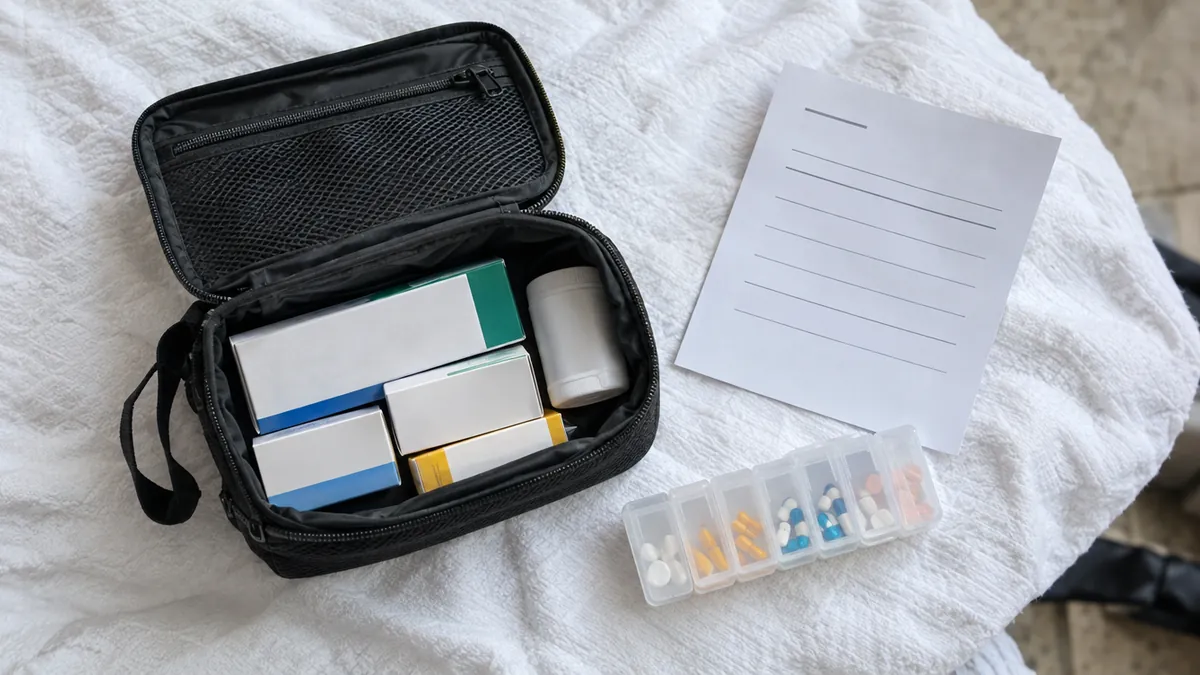
Three habits make the airport easy. Keep every medicine in the box it was dispensed in, with the pharmacy label showing your name. Carry the prescription or report in your hand luggage with the medicines, not in the hold. And carry it in English or Arabic; the SFDA documents do not state a language requirement, but a customs officer at 3 a.m. cannot read a prescription in Urdu or Tagalog.
Controlled medicines: how to get the SFDA permit
Since February 2025 the SFDA has run an electronic Traveler Permit for Controlled Drugs, and since 1 November 2025 the current guidelines require it for anyone carrying medicines containing narcotic or psychotropic substances into or out of the Kingdom. The SFDA's May 2026 notice to pilgrims repeats the same route. The steps below follow those notices.
- Go to cds.sfda.gov.sa and create a Personal Traveler Account in the Controlled Drugs System.
- Start a traveller clearance application and enter the medication details: trade name, active ingredient, concentration and quantity, plus your dates of stay.
- Upload a copy of your passport, a valid prescription or medical report issued within the past six months, and a photo of the medicine and its outer packaging.
- Agree to the electronic declaration in the application and submit.
- Wait for approval. The SFDA publishes no processing time and tells travellers to apply "well in advance"; two to three weeks before travel is a sensible margin.
- Print or save the permit. Show it at the port of entry with the medicines and keep it with you during your stay; the same permit covers your departure with any remaining supply.
Which medicines count as narcotic or psychotropic?
The SFDA points to the schedules of the Anti-Narcotics Law, published in Arabic on its site. They cover opioids such as morphine, codeine combinations and tramadol, benzodiazepines used for sleep and anxiety, stimulants prescribed for ADHD, and a range of other substances. Some medicines sold freely in Pakistan, India, the Philippines or Egypt sit on the Saudi list, so the test is not "is it controlled at home" but "is it on the Saudi schedule". When in doubt, apply; an unnecessary application costs you nothing, while a missing one can cost the trip.
Insulin, injections and medical devices
Insulin, GLP-1 pens, anticoagulant injections and similar prescription medicines are not controlled drugs. They travel in the green group: original packaging, within expiry, prescription or report under six months old, and the three-month (or one-month pilgrim) quantity cap. The needles, pen tips, lancets, glucose strips and nebuliser or CPAP consumables that go with them are medical supplies, cleared under the pilgrim rules for one month of use or the length of stay with a report showing the need.
Practical points: carry insulin in hand luggage in a cool bag, because hold temperatures and the heat on Makkah buses both damage it; carry a spare pen; and ask your airline in advance about its cabin rules for sharps, since those are airline rules rather than SFDA rules.
Hajj and Umrah pilgrims: what is different
Pilgrims fall under the SFDA requirements issued for each Hajj season, which cover three groups: Hajj mission medical offices, doctors travelling with Hajj groups, and medicines in the personal possession of pilgrims. For the last group the rules are the ones in the table above: one month of non-controlled medicines or length of stay, 30 days of controlled medicines with CDS approval, original packaging, valid expiry, no products with unknown formulation or false claims, and disposal of any surplus. The SFDA's May 2026 notice to pilgrims repeats the CDS requirement for narcotic and psychotropic medicines.
Group leaders cannot carry medicines for the group. Doctors accompanying Hajj groups may bring emergency supplies under a Ministry of Health letter, but the SFDA prohibits them from carrying narcotic or controlled drugs for pilgrims and requires them to re-export what is left. Residents performing Hajj register through Nusuk; our Hajj for residents guide covers permits and vaccinations, and the Umrah visa guide covers visitors. If you are budgeting a trip from Pakistan, the Umrah cost breakdown includes a line for medicines and insurance.
At the airport: declaring, and what customs can do
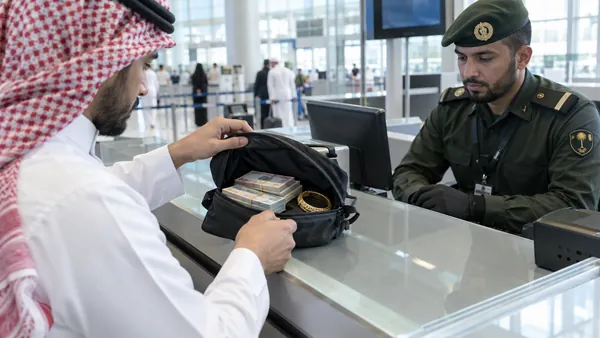
Personal medicines within the limits above are normally waved through by ZATCA officers under the SFDA's delegation. Items that need approval, and anything restricted, must be declared. ZATCA's traveller declaration e-service is the same form used for cash, gold and valuables of SAR 40,000 or more (see our cash declaration guide); you can complete it online before landing or at the red channel. If an officer is unsure about a product, the case is referred to the SFDA, which decides and informs customs, so allow time if you carry anything unusual.
If something is refused, you can usually abandon it for destruction and continue your journey; carrying undeclared controlled substances is the scenario that turns into an arrest. For residents, the simplest long-term answer is to move your prescriptions to a Saudi doctor within the first three months, which also gives you a local prescription if you ever need to prove the medicine is yours. Visitors should bring the exact quantity for the trip, the paperwork, and nothing they cannot explain.
Frequently asked questions
Can I bring my prescription medicine to Saudi Arabia?
Yes, for personal use. The Saudi Food and Drug Authority (SFDA) conditions for individuals allow prescription medicines in their original packaging and within expiry, backed by a prescription or medical report that states the diagnosis, the medicine, the dose and the duration of treatment, approved by the treating institution and no more than six months old. The quantity is limited to three months of use, or one month for Hajj and Umrah pilgrims under the SFDA pilgrim rules, or the length of your stay if that is shorter. Narcotic and psychotropic medicines are different: they need prior SFDA approval through the Controlled Drugs System.
How many months of medication can I carry into Saudi Arabia?
Up to three months of ordinary prescription or over-the-counter medicines, vitamins and supplements under the SFDA conditions for personal use (version 3.0, dated 26 October 2025), and the same request cannot be repeated within that period. Narcotic or psychotropic medicines are capped at a 30-day supply or the length of your stay, whichever is shorter, with prior approval. Pilgrims are held to a tighter limit under the SFDA Hajj requirements: one month of non-controlled medicines or the length of stay, whichever is less. Anything beyond your documented need is refused and destroyed.
Which medicines need SFDA approval before travelling to Saudi Arabia?
Any medicine containing a narcotic drug or a psychotropic substance under the Saudi Anti-Narcotics Law schedules. In practice that means strong opioid painkillers, benzodiazepine sleeping tablets and tranquillisers, stimulant medicines for ADHD, and some other medicines that act on the nervous system. The Saudi schedules are broader than many countries, so if your medicine is controlled at home, or your pharmacist is unsure, apply for the traveller clearance permit on cds.sfda.gov.sa before you fly. The permit has been required for arriving and departing travellers since the service launched in February 2025, with the current guidelines in force from 1 November 2025.
How do I apply for the SFDA traveller permit for controlled drugs?
Create a Personal Traveler Account on the SFDA Controlled Drugs System at cds.sfda.gov.sa, then submit an application with a copy of your passport, a valid prescription or medical report issued within the past six months, a photo of the medicine and its outer packaging, and the medication details (trade name, active ingredient, concentration and quantity). You agree to an electronic declaration in the application. Once approved, you show the permit at the port of entry and keep it with the medicine during your stay. The SFDA does not publish a processing time, so apply well before travel.
Can I take insulin and needles to Saudi Arabia for Hajj or Umrah?
Yes. Insulin is a prescription medicine, not a controlled drug, so it falls in the allowed group with a prescription or medical report no older than six months. Needles, pen tips, glucose strips and similar items count as medical supplies, which the SFDA pilgrim rules clear for one month of use or the length of stay with a medical report. Keep everything in original packaging, carry it in hand luggage with the paperwork, and use a cool bag; Saudi airports and buses are hot. Ask your airline about its cabin rules for sharps before you fly.
What medicines are banned in Saudi Arabia?
The SFDA refuses clearance to medicines in Category D of Schedule One and Category A of Schedule Two of the Anti-Narcotics Law, and to the substances listed in paragraph Fourth of its schedules; these have no accepted medical use and no permit is possible. It also refuses products with misleading medical claims (weight loss, weight gain, whitening, sexual performance), herbal mixtures of unknown composition or source, blood derivatives and vaccines, medicines that must be used under medical supervision, expired medicines, loose tablets without original packaging, and anything radioactive. ZATCA separately bans unregistered pills, creams, sexual tonics, abortion pills and herbs, and nutmeg.
General information only, not legal advice. We are not affiliated with any Saudi government authority.