Last updated
Umrah Visa for Visitors from Abroad: Which Visa Fits Which Traveller, the Fee, the 90-Day Rule and the New One-Year Option
An Umrah visa is the visitor visa Saudi Arabia issues to Muslims from abroad who come to perform Umrah. It is issued against a Nusuk package or through a licensed agent, costs about SAR 300 plus the package, must be used to enter within one month of issue and allows a 90-day stay. Nationals of 68 countries can use the tourist e-visa instead; a one-year multiple-entry Umrah visa arrived in July 2026.
This page is for people outside the Kingdom. If you already hold an iqama, you do not need any visa; you need a permit, and our Umrah guide for residents covers that. For everyone else the real question is not "how do I get an Umrah visa" but "which of the four or five visas that allow Umrah is the right one for my passport and my plans". That is how this guide is organised.
Which visa fits which traveller
Start with your passport, then your plans. The table uses the rules published by the Ministry of Hajj and Umrah, Visit Saudi and my.gov.sa as of 24 October 2026.
| You are | Best fit | Where it is issued | Validity and stay | What you pay |
|---|---|---|---|---|
| A national of one of the 68 e-visa countries (UK, EU, US, Canada, Australia, Japan, Malaysia, Singapore, Turkey and others) | Tourist e-visa, Umrah allowed | visa.visitsaudi.com, online | One year, multiple entry, up to 90 days in the country | SAR 535 including health insurance, per Visit Saudi |
| Any nationality holding a valid US, UK or Schengen visa | Tourist visa on arrival | Visa office at the Saudi airport | As the tourist visa | Visit Saudi lists SAR 480 |
| A national of Pakistan, India, Bangladesh, Indonesia, Egypt, Nepal, Sri Lanka or another country not on the e-visa list | Umrah visa | Nusuk Umrah package, or a licensed Umrah agent in your country | Enter within 1 month (30 days) of issue, stay up to 90 days | About SAR 300 visa fee, inside the package price |
| A frequent pilgrim from any of those countries | Multiple-entry Umrah visa | Through accredited providers on Nusuk, one package per visit | 365 days from issue, 90 days in total across visits | Set by the package each visit |
| Visiting a relative who lives in Saudi Arabia | Family visit visa, Umrah allowed | Relative applies on the KSA Visa platform | Single or multiple entry, see our visit visa guide | SAR 300 plus insurance |
| A GCC citizen | No visa needed | National ID at the border | No visa limit; Nusuk permit still required | Nothing for entry |
| A resident of another GCC country, not a citizen | Check the KSA Visa platform by nationality and residence | ksavisa.sa | Depends on the visa offered | Shown at payment |
If your passport qualifies for the tourist e-visa, that is usually the easier purchase: no package, and it lasts a year. If not, the Umrah visa is your route and the package is not optional; see our Umrah cost from Pakistan breakdown for real prices.
The standard Umrah visa: fee, entry window and the 90 days
The Ministry of Hajj and Umrah describes two ways to obtain the visa. You can build your own programme on an approved electronic platform, the ministry names Nusuk, or you can go through your external agent, meaning the accredited Umrah office in your country, which obtains the visa for you. Either way, the ministry is clear that an Umrah visa cannot be issued without service packages covering accommodation and transport.
| Question | Ministry answer |
|---|---|
| Fee | Estimated at about SAR 300 for arrivals from outside the Kingdom |
| Entry deadline | Within one month (30 days) of issue; unused visas are cancelled |
| Length of stay | 90 days |
| Extension | Not beyond 90 days, and not into the Hajj season |
| Cities | Makkah, Madinah and all other cities during the permitted stay |
| Airports | Any international or regional airport; arrive by one mode, leave by another if you wish |
| More than one visa a year | Allowed |
| Women without a mahram | Allowed |
| Fingerprints before travel | Required for some nationalities through the Saudi Visa Bio app; the FAQ lists the UK, Tunisia, Kuwait, Bangladesh and Malaysia |
| Visa refused | Umrah visas fall under the Ministry of Foreign Affairs, which handles rejections |
One FAQ answer still says entry must be within three months and the stay must not exceed thirty days. Both lines are out of date: the entry window was cut to one month in November 2025, as the Saudi Gazette reported, and the stay is 90 days.
Does the Umrah visa include health insurance?
Visitor health insurance is compulsory for visit visas and is collected with the visa or package rather than bought separately, which is why the SAR 300 figure never appears alone on your receipt. The cover is emergency-focused and the limits are explained in our visit visa medical insurance guide.
The one-year multiple-entry Umrah visa
On 20 July 2026 the Ministry of Hajj and Umrah introduced a multiple-entry Umrah visa, reported by the Saudi Gazette and the Saudi Press Agency. It is valid for 365 days from the date of issue and allows a total stay of 90 days, counted cumulatively across every visit. The ministry attached four conditions.
- For each visit, buy a service package from one of the accredited providers listed on Nusuk.
- Before each entry, obtain an Umrah permit in the Nusuk app, with permit dates that match the package dates.
- The length of any package cannot exceed the number of days still left on the visa.
- The visa cannot be used to enter the Kingdom during the Hajj season.
It suits pilgrims within a short flight, business travellers adding Umrah to repeat trips, and families splitting Makkah and Madinah into short visits. It does not help anyone planning one long stay, because the 90-day total is unchanged and the package rule applies on every trip. No separate fee table has been published; the cost sits inside each package.
How to apply through Nusuk Umrah or an agent
The Nusuk Umrah platform describes itself as a one-stop shop under the ministry that provides everything from visa issuance to package booking without external agents, for visitors from the countries the ministry has opened to individual booking. If your country is not yet open on the platform, the licensed agent route still works. The steps below follow the platform's own flow.
- Register on umrah.nusuk.sa with your passport details. The platform verifies your data and shows packages available for your country.
- Choose a package marked "visa included", or a package without visa if you already hold a tourist, visit or other valid visa.
- Pick the cities and nights. Packages combine hotel, transport and often flights, meals and a Rawdah booking.
- Pay. The visa application is lodged against the package. If your nationality needs biometrics, complete the Saudi Visa Bio registration when prompted.
- Receive the e-visa, then book the Umrah permit in the Nusuk app for your arrival dates. Some providers do this for you; check before you fly.
Umrah on a tourist, family visit or other visa
Visit Saudi states that the tourist e-visa allows Umrah, excluding Hajj, and the Nusuk Umrah platform sells "packages without visa" to GCC citizens, residents and holders of all visa types. So a British, Malaysian or Turkish pilgrim can land on a tourist e-visa, book a hotel independently and perform Umrah with a free Nusuk permit. A Pakistani or Indian relative on a family visit visa can do the same while staying with family. Check your relative's options in the family visit visa guide.
The permit is the common thread. Every pilgrim, resident or visitor, books a dated slot in the Nusuk app before entering the Grand Mosque to perform Umrah. Prayer in the Haram needs no permit; only the Umrah itself does. The mechanics of booking, companions and cancellation are the same for visitors as for residents, and they are explained in the residents' guide.
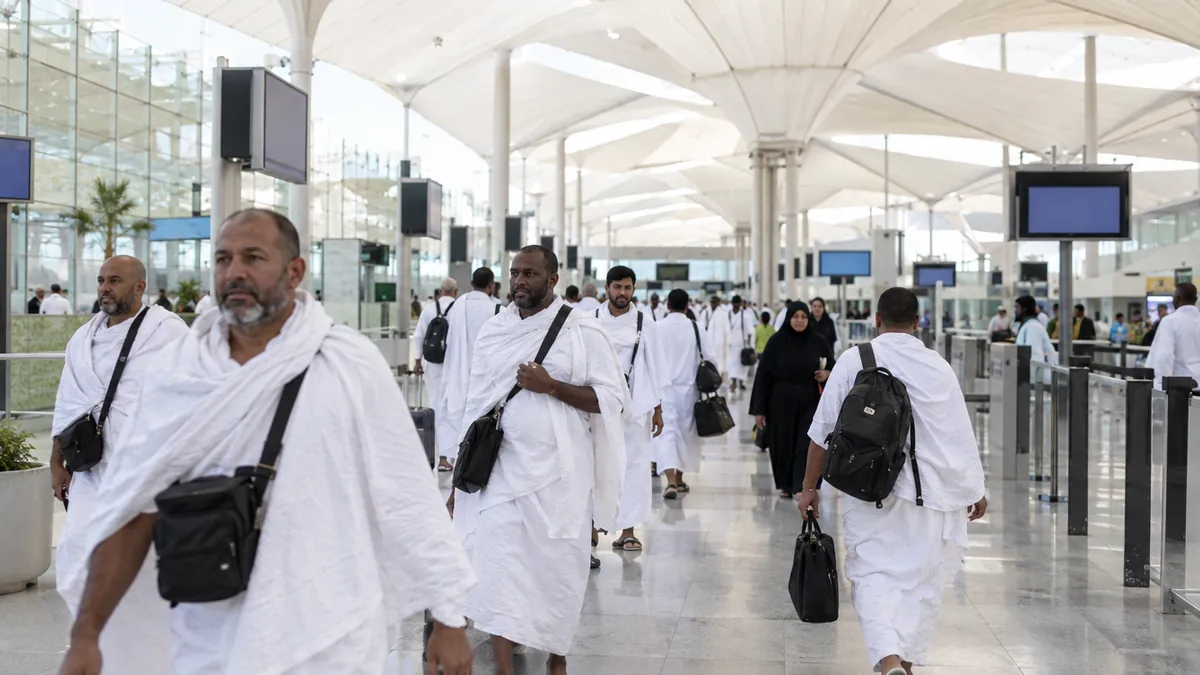
Air travellers must enter ihram before the miqat, and the ministry reminds pilgrims that Jeddah airport is not one; our miqat locations guide has the boundaries by route, and the Haramain train links the airport to Makkah and Madinah.
Season dates and the Hajj cut-off
Umrah visas run on a season that closes before Hajj. For the current 1448 season, the Ministry of Hajj and Umrah announced the calendar on 17 May 2026.
| Milestone, 1448 season | Hijri date | Gregorian date |
|---|---|---|
| Umrah visas issued and entry opens | 14 Dhul Hijjah 1447 | 31 May 2026 |
| Last day to issue an Umrah visa | 1 Shawwal 1448 | 9 March 2027 |
| Last day to enter the Kingdom | 15 Shawwal 1448 | 23 March 2027 |
| Last day to leave | 30 Shawwal 1448 | 7 April 2027 |
Every Umrah visitor must be out of the Kingdom by 7 April 2027. This season the last day to leave is 30 Shawwal, not 1 Dhul Qadah as it was in 1447, so do not plan on last season's pattern. For comparison, the ministry's 1447 calendar was as follows.
| Milestone, 1447 season | Hijri date | Gregorian date |
|---|---|---|
| Umrah visas start being issued | 14 Dhul Hijjah 1446 | 10 June 2025 |
| Last day to issue an Umrah visa | 1 Shawwal 1447 | 20 March 2026 |
| Last day to enter the Kingdom | 15 Shawwal 1447 | 3 April 2026 |
| Last day to leave | 1 Dhul Qadah 1447 | 18 April 2026 |
Use the Hijri date converter to line these dates up with your leave, and the prayer times tool for Makkah once you land.
Visa holder or resident: what people get wrong
The most common error is the belief that an Umrah visa confines you to Makkah, Madinah and Jeddah. That was the rule years ago. The ministry's FAQ now says the visa allows travel between Makkah, Madinah and all other cities, through any airport, so a Riyadh or AlUla leg is fine within the 90 days. The second error is the mahram myth. The ministry's answer on whether a woman may come for Umrah without a mahram is a plain yes.
The third is mixing up the two documents. Residents never need an Umrah visa; their iqama is their status, and the Nusuk permit is what the gate checks. Visitors need both the visa to enter the country and the permit to perform the rite. A resident who buys an "Umrah visa" from an agent has bought nothing, and a visitor who arrives with a visa but no permit will be asked to book one on the spot, when slots may be gone.
Finally, price. The SAR 300 fee is never the whole bill; the package rule means your real cost is hotel nights, transport and the provider's margin, so convert carefully with the SAR exchange rates tool before paying an agent in your home currency.
Frequently asked questions
How much does an Umrah visa cost?
The Ministry of Hajj and Umrah FAQ puts the Umrah visa fee at about SAR 300 for pilgrims arriving from outside Saudi Arabia. You do not pay it on its own. The visa is issued against a service package, covering at least accommodation and transport, bought from an accredited provider on the Nusuk platform or through a licensed Umrah agent in your country, so the amount you actually pay is the package price with the visa, insurance and service charges inside it. Nationals of the 68 e-visa countries can instead buy the tourist e-visa, listed by Visit Saudi at SAR 535 including health insurance.
How long is an Umrah visa valid?
Since November 2025 you must enter Saudi Arabia within one month (30 days) of the issue date, or the visa is cancelled automatically. Once you arrive, the stay allowed on a standard Umrah visa is still 90 days. The system does not allow an extension beyond 90 days, and the visa cannot be stretched into the Hajj season. Since July 2026 there is also a multiple-entry Umrah visa valid for 365 days from issue, with a total stay of 90 days spread across as many visits as you like, each visit backed by a Nusuk package.
Can I perform Umrah on a tourist visa?
Yes. Visit Saudi states that the tourist e-visa allows Umrah, excluding Hajj, alongside events, family visits and leisure. The same applies to holders of other visit visas: the Nusuk Umrah platform sells packages without a visa to GCC citizens, residents and holders of all visa types. Whatever visa you hold, you still book a free Umrah permit in the Nusuk app for a date and time before entering the Grand Mosque, and permits are paused for several weeks around Hajj.
Which countries can get a Saudi e-visa for Umrah?
The Visit Saudi e-visa portal lists 68 eligible countries, including the UK, all EU states, the US, Canada, Australia, Japan, South Korea, China, Malaysia, Singapore, Turkey, Kazakhstan, South Africa and Mauritius. Pakistan, India, Bangladesh, Indonesia, Egypt, Nepal and Sri Lanka are not on the list, so pilgrims from those countries use the Umrah visa through Nusuk or a licensed agent, or a family visit visa if a relative in the Kingdom sponsors them. Holders of a valid US, UK or Schengen visa can apply for a visa on arrival.
Can a woman travel for Umrah without a mahram?
Yes. The Ministry of Hajj and Umrah FAQ answers the mahram question plainly: a woman may come to perform Umrah without a mahram. There is no age condition attached to that answer. Women book the same packages and permits as men. Ihram dress for women is ordinary modest clothing in any colour, and the permit slot in the Nusuk app is checked at the Grand Mosque entrances regardless of gender.
Can I visit Riyadh or other cities on an Umrah visa?
Yes. The ministry FAQ says the Umrah visa allows travel between Makkah, Madinah and all other cities during the permitted stay, and that you may enter and leave through any international or regional airport, even using different airports or modes of transport for arrival and departure. The older restriction to Makkah, Madinah and Jeddah no longer applies. Your package may still fix your hotel nights, so plan extra cities around those dates.
General information only, not legal advice. We are not affiliated with any Saudi government authority.