Last updated
Cash Declaration Limit in Saudi Arabia: The SAR 40,000 Threshold, How to Declare and the Penalties
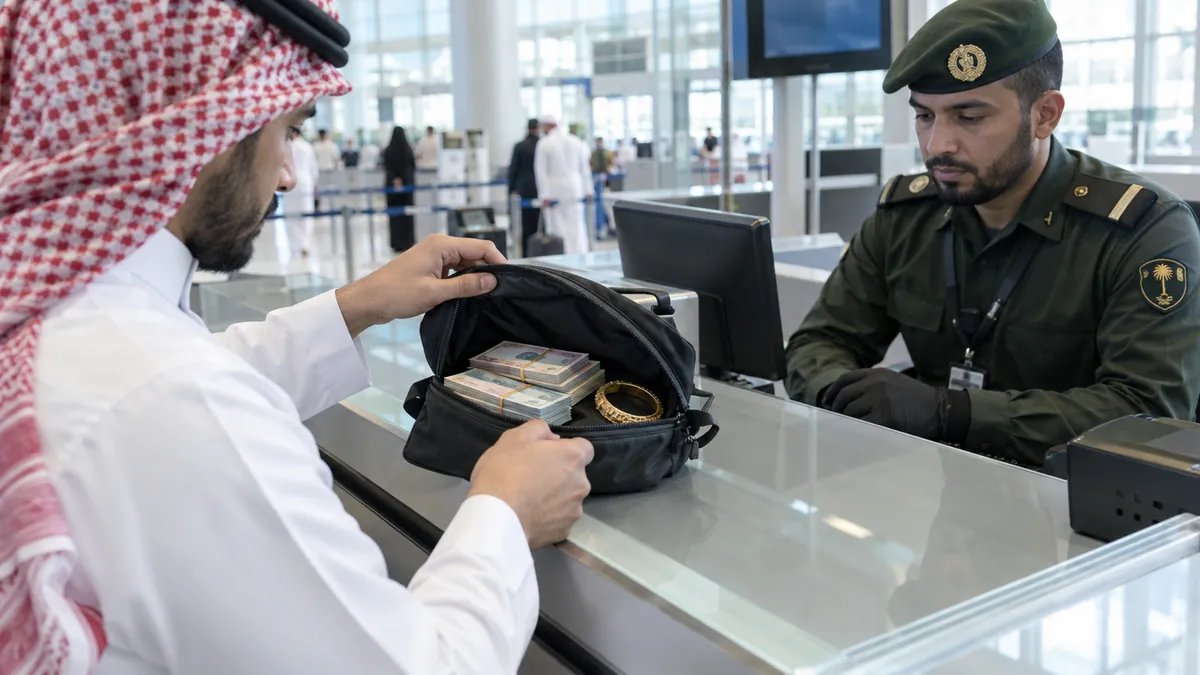
The cash declaration limit in Saudi Arabia is now SAR 40,000. Anyone entering or leaving the Kingdom with cash, cheques, gold, precious metals, gemstones or jewellery worth SAR 40,000 or more, or the same in foreign currency, must declare it to customs (ZATCA). It is a declaration threshold, not a cap: you may carry more if you declare it and can prove where it came from.
If you have read that the limit is SAR 60,000, that figure is out of date. This guide explains what changed, what counts toward the total, how to declare step by step, and what the fines look like.
SAR 40,000, not SAR 60,000: what changed in 2026
For years, Saudi customs asked travellers to declare cash and precious metals worth SAR 60,000 or more. In June 2026, Okaz reported that the updated implementing regulations of the Anti-Money Laundering Law had lowered the figure to SAR 40,000 for gold bars, precious metals, gemstones and worked jewellery, with a written declaration at the customs port and a purchase invoice to prove the value.
The ZATCA e-service for traveller declarations now uses the same figure for cash too. Both its English and Arabic pages list "currencies, bearer negotiable instruments, gold bars, precious metals, gemstones and jewelry of a value of 40,000 riyals or more or their equivalent in foreign currencies" as items to declare, both for arrivals and for departures.
A declaration threshold, not a spending cap
This is the single biggest misunderstanding. People hear "limit" and think the law stops them carrying more than SAR 40,000. It does not. Nothing in the ZATCA service says you may not carry SAR 80,000 or SAR 200,000. It says you must tell customs about it and support it with papers.
The offence is staying silent, or declaring a smaller amount than you really have. A traveller with SAR 100,000 who declares it properly and shows a bank withdrawal slip is following the rules. A traveller with SAR 45,000 in a jacket who walks past customs without declaring is not.
Why does Saudi Arabia ask for declarations at all?
The rule sits inside the Anti-Money Laundering framework. Cash and gold are easy to move across borders without a record. A declaration creates that record, and the proof-of-source papers let customs separate honest savings from money linked to crime. That is why the penalty changes sharply if there is any suspicion of laundering.
What counts toward the SAR 40,000
| Item | Counts? | Notes |
|---|---|---|
| Saudi riyals in cash | Yes | Notes and coins |
| Foreign currency (dollars, rupees, pesos, etc.) | Yes | Converted to the riyal equivalent |
| Bearer negotiable instruments | Yes | Such as traveller's cheques or cheques payable to the bearer |
| Gold bars and coins | Yes | Keep the invoice |
| Other precious metals and gemstones | Yes | Silver, platinum, loose stones |
| Jewellery | Yes | Including pieces you are wearing |
| Money on your bank card or in a wallet app | No | Not physical cash |
ZATCA groups all of these in one line with a single SAR 40,000 value, so the careful reading is to add them together. A traveller with SAR 25,000 in cash and SAR 18,000 of gold jewellery is carrying SAR 43,000 of declarable items. To value your gold, use today's per-gram price on our gold rate tool, and for foreign notes use the SAR exchange rates tool.
Does each family member have a separate SAR 40,000?
The ZATCA service is built around the individual traveller: each person files their own declaration with their own details. What ZATCA does not spell out is how officers treat a family carrying cash for one another, for example a father holding his children's share. If your family together is near the threshold, declare. It costs nothing and removes the argument.
Is the list different on arrival and on departure?
Yes. On departure, ZATCA limits the declaration list to two things: cash and valuables worth SAR 40,000 or more, and items that may not be exported, such as antiquities, or subsidised goods. On arrival the list is longer. As well as the SAR 40,000 items, you must declare goods in commercial quantities or worth more than SAR 3,000, goods subject to excise tax, and prohibited or restricted items. So a returning resident carrying new goods worth more than SAR 3,000 may need to declare on arrival even with no cash at all.
How to declare: the ZATCA traveller declaration (الإقرار الجمركي)
The declaration is free. ZATCA's user manual lays out these steps:
- Go to zatca.gov.sa and open E-Services from the top menu.
- Search for and select Submit Customs Declaration for Travelers.
- Choose your applicant type (Citizen / Resident, or Visitor), or review a previous declaration.
- Choose Arriving or Departing.
- Fill in the item details (type of item and value) and press Continue.
- Review the items and the total, then press Continue.
- Enter your personal, trip and contact information.
- Accept the terms and conditions and press Submit.
- Note the reference number on the confirmation screen.
At the airport, land border or seaport, give the reference number to the customs officer to finish the process. The updated regulations, as reported, require the declaration to be made in writing at the customs port, so plan a few extra minutes at the customs desk rather than walking straight to immigration.
What documents should I carry?
ZATCA asks for the completed declaration form and, when declaring money, financial instruments, gold, precious metals or jewellery worth SAR 40,000 or more, official papers that prove ownership and explain where the money or property came from. Useful examples: a bank withdrawal receipt, a gold shop invoice, a car sale contract, or an end-of-service settlement letter.
Penalties for not declaring
Okaz's June 2026 report on the updated regulations set out this structure. We list it as reported, because the full regulation text was not available to us on an official Saudi site.
| Situation | Consequence |
|---|---|
| Undeclared or falsely declared items | ZATCA may seize the money or metals for up to 72 hours |
| First violation, no suspicion of money laundering | Fine of 10% to 25% of the seized value |
| Repeat violation, no suspicion | Fine rises to 50% of the seized value |
| Suspected money laundering or a predicate crime | Referral to the Public Prosecution and the General Department of Financial Investigations |
| Goods judged to be commercial | Handled under the Unified Customs Law |
Common situations for expats
Going home on final exit with savings
This is when most residents come close to the threshold, because years of savings and the end-of-service payment arrive at once. Carrying it as cash is the riskiest option. Your Saudi bank account has to be closed when you leave on final exit, so move the money to your home account before you go. Our guide to sending money from Saudi Arabia shows how to compare the real cost.
Travelling with gold for a wedding
Gold bought for a family wedding can reach SAR 40,000 quickly. Declare on departure with the invoices, and check the rules in the country you are flying to. For India, our guide on how much gold is allowed from Saudi Arabia to India covers the duty-free weights.
Using cards instead of cash
Money on your bank card does not count toward the threshold. For spending abroad, a card is often simpler than carrying notes; see what to set up first in our guide to using a mada card abroad.
One last point: the destination country has its own declaration rules, and Saudi rules do not replace them. Check both before you fly. For questions about a specific case, ZATCA's contact number is 19993.
Frequently asked questions
What is the cash declaration limit in Saudi Arabia?
Travellers entering or leaving Saudi Arabia must declare currencies, bearer negotiable instruments, gold bars, precious metals, gemstones and jewellery worth SAR 40,000 or more, or the equivalent in foreign currency. This is the figure on the ZATCA traveller declaration service. Many older articles still quote SAR 60,000, which was the previous threshold before the Anti-Money Laundering implementing regulations were updated in 2026.
Is SAR 40,000 the maximum cash I can carry out of Saudi Arabia?
No. SAR 40,000 is the point at which you must declare, not a ceiling on what you may carry. You can carry more if you declare it and can show official papers proving ownership and the source of the money, such as a bank withdrawal slip or sale contract. The offence is failing to declare or declaring false information, not carrying a large amount.
How do I declare cash at a Saudi airport?
Use the ZATCA e-service called Submit Customs Declaration for Travelers on zatca.gov.sa. Choose your applicant type, choose arriving or departing, enter the items and their value, add your personal and trip details, accept the terms and submit. Keep the reference number and show it to the customs officer at the port, together with your proof of ownership and source of funds, to complete the declaration.
What is the penalty for not declaring cash in Saudi Arabia?
As reported from the updated Anti-Money Laundering implementing regulations, a first violation with no suspicion of money laundering carries a fine of 10 to 25 percent of the value of the seized amount, rising to 50 percent for a repeat violation. ZATCA can hold undeclared money or metals for up to 72 hours, and suspected money laundering cases are referred to the Public Prosecution.
Does gold jewellery count towards the SAR 40,000 declaration limit?
Yes. ZATCA lists jewellery, gemstones, gold bars and precious metals in the same line as cash and bearer negotiable instruments. If the combined value of what you carry reaches SAR 40,000, declare it. Keep the jeweller invoices, because the updated regulations require proof of purchase to show the value of gold or jewellery being declared.
Do I need to declare cash below SAR 40,000?
No declaration is required for cash and valuables below SAR 40,000. However, customs officers can still ask questions, and the country you are flying to has its own rules. If you are carrying an amount close to the threshold, or cash plus gold that together come near it, declaring is the safer choice because a declaration below the limit costs you nothing.
General information only, not legal advice. We are not affiliated with any Saudi government authority.