Last updated
Water Bill Check in Saudi Arabia: Why Your NWC Bill Doubled and How to Prove a Leak
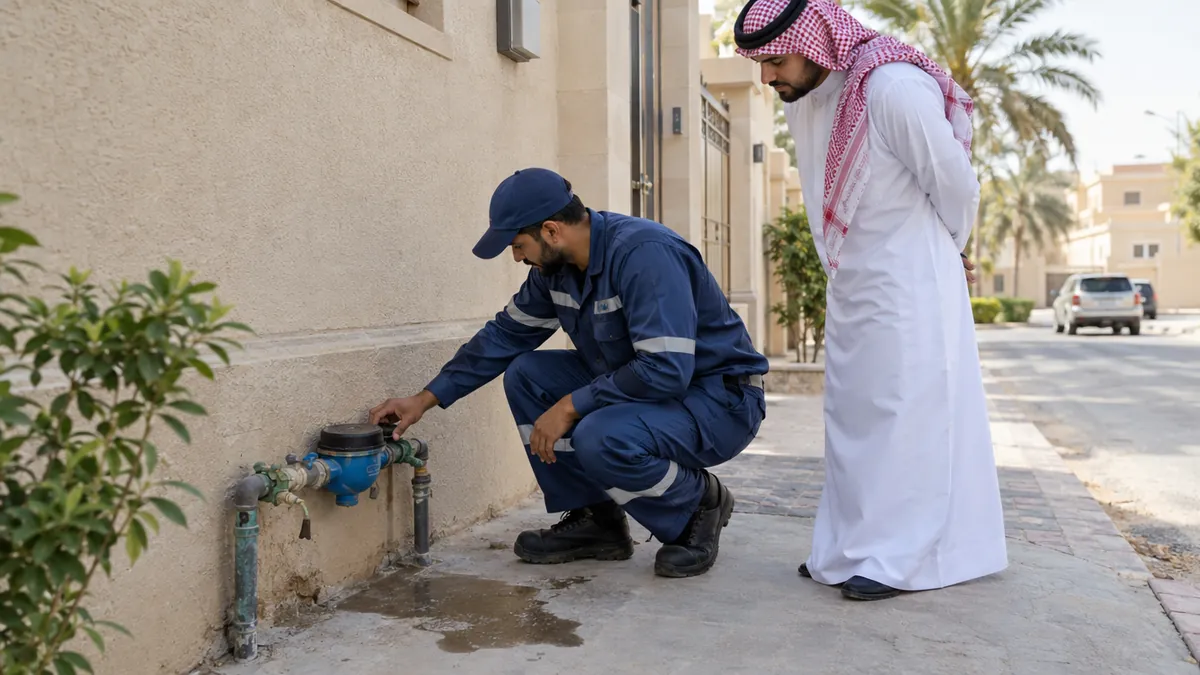
For a water bill check in Saudi Arabia, log in to the National Water Company (NWC) app or e-branch and open Bills list, or look up the bill in your bank app under SADAD with your water account number. If the amount has jumped, NWC says 93% of high-consumption cases come from leaks inside the home.
Most people only look closely at the water bill when it suddenly doubles. That is what this guide is about. We cover how to see the bill, the real reasons bills jump, the leak tests NWC itself recommends, and how to build evidence before you complain. We also explain an uncomfortable rule many tenants do not know: who pays for water lost through a leak.
How to check your NWC water bill
On the NWC app or e-branch
- Log in to the NWC e-branch or the NWC mobile app.
- Choose Our Services from the top menu.
- Click Bills list to see the current bill and earlier ones.
Looking at several months side by side is the fastest way to spot when a problem started. A leak usually shows as a step up that stays high, while a one-off spike often points to a long reading period or a catch-up bill.
Through your bank app
Saudi bank apps include SADAD bill payments. Add the National Water Company as a biller, enter the water account number, and the app shows the amount due. This works even if you have not registered with NWC, which helps new tenants.
What if I do not know my account number?
It is printed on the bill. Without a bill, use the NWC service for adding an existing account: you can search by account number, meter serial number, or select the property on a map. The current owner must approve before the account appears on your profile. Owners can also add a tenant through Beneficiary Management, choosing whether the beneficiary has financial liability or not, and the account is added once the tenant accepts.
Why the bill doubled: the usual causes
In October 2026 NWC launched a national campaign on household leaks and shared the results of its field studies. It found two main causes of high consumption. Internal leaks made up 93% of cases. The second cause was property data and unit divisions that had not been updated.
Leaks you cannot see
NWC says the most common leak points are the float valve and the neck of the underground tank, plus the flush valve in toilets. None of these drip on the floor. A stuck float lets the tank overflow quietly into the ground, and a worn flush valve can run into the bowl all day and night. These leaks are why a bill can rise while nobody in the house has changed their habits.
Out-of-date property information
Water charges in Saudi Arabia are calculated in rising consumption tiers (شرائح), so the more cubic metres a unit uses, the higher the price of each extra metre. When the tiered tariff was revised in 2016, Okaz newspaper reported that the rate on some blocks rose from 10 halalas to SAR 9 per cubic metre. Because of this, the property details on your account matter. If a building with several flats is recorded as fewer units than it really has, more of its water can land in the expensive tiers. From 1 January 2027 the number of units on the meter also sets the fixed monthly fee, SAR 20 for water and SAR 10 for wastewater for each extra unit, so check the unit count on your account before January. NWC has services to amend the property classification, building area and property information if yours is wrong.
Long periods and catch-up bills
Check the reading dates on the bill. A bill that covers more days than usual, or one that follows a gap where no bill was issued, will be larger even if daily use is normal. Divide the consumption by the number of days to compare fairly with earlier bills.
The new water tariff from 1 January 2027
On 25 October 2026 NWC announced an adjusted water and wastewater tariff that starts on 1 January 2027. Until 31 December 2026 the current tariff still applies. From January, households pay for water in four monthly bands, plus wastewater at half those rates where the home is connected to the sewer network.
| Water used in the month | Water, per m³ | Wastewater, per m³ |
|---|---|---|
| Up to 15 m³ | SAR 1 | SAR 0.50 |
| 15 to 30 m³ | SAR 2 | SAR 1 |
| 30 to 45 m³ | SAR 4 | SAR 2 |
| Above 45 m³ | SAR 6 | SAR 3 |
The old meter service fee becomes a fixed monthly fee set by meter size. For a meter of 20 mm or less it is SAR 20 for water and SAR 10 for wastewater, and the same again for each extra residential unit on that meter. All of these prices are before 15% VAT. NWC's own example is a home that uses 30 m³ in a month: 15 m³ at SAR 1 and 15 m³ at SAR 2 make SAR 45 for water, wastewater adds SAR 22.50, and the fixed fee adds SAR 30, so the bill is SAR 97.50 before VAT. A bill whose reading period crosses 1 January is split, with each part charged at the tariff for its own period.
How to prove a leak with NWC's own tests
NWC publishes a step-by-step guide for detecting leaks inside a property. Do the tests in this order, take dated photos of the meter and tank levels, and write down each result. That record is your evidence.
- Whole-house meter test: close every tap and water outlet in the home, then watch the meter. NWC advises checking the meter connection and both the ground and roof tanks to make sure no water is flowing. If the meter still moves, water is escaping somewhere.
- Ground tank test: fill the tank, close the valve after the meter that feeds it, switch off the pump, and make sure nothing draws water. Measure from the opening to the water surface, wait at least an hour, and measure again. If the distance has grown, the tank is leaking.
- Tank shaft and float: look for cracks in the access shaft walls. Check the float for holes and a sound arm and joint, and watch it rise to close the inlet when the tank is full.
- Meter-to-tank pipe: while the tank is filling, lift the float by hand to close the inlet. If the meter stops, the pipe between the meter and tank is sound. If it keeps reading, that pipe is leaking.
- Roof tank: check the body for cracks and watch the float valve close the inlet when the tank is full.
- Downpipes from the roof tank: close all valves in the house and on the downpipes, wait 15 minutes, then slowly open the first downpipe valve. If you hear water rushing in, that line has a leak. Repeat for each line.
- Pumps: if the lift pump keeps cycling without extra use, or the pressure pump runs while nobody is using water, suspect a leak in the internal network.
- Toilets: put a little food colouring in the cistern and wait 5 minutes without flushing. If the colour appears in the bowl, the flush mechanism is leaking.
- Taps and pipes: inspect kitchen, bathroom, laundry and garden taps and pipes for visible leaks.
NWC says repairing leaks and fitting approved water-saving fittings can cut consumption by up to 46% and bills by up to 60%. Fittings carrying the Water Conservation label alone can save about 30% of average use.
What people get wrong: proving a leak does not cancel the bill
This is the point that surprises most residents. NWC cites the Water and Wastewater Services Guide from the Saudi Water Authority, which says the consumer is responsible for internal leaks in the property, and that the meter is where the provider's responsibility ends. In plain terms, if water passed through a working meter and then leaked from your tank or pipes, it counts as your consumption.
So a leak test has two jobs. First, it shows you where to send the plumber so the next bill falls. Second, it helps you separate cases where you do have a complaint:
- The meter keeps moving after every internal test passes. That points to the meter, so request a meter inspection.
- The reading on the bill is higher than the reading on your meter. That is a billing error.
- The leak is on the street side of the meter or at the meter box. That is NWC's side, and you report it as a water incident.
- Your property details are wrong. Ask NWC to correct them.
Complaints, meter inspection and paying a big bill
| NWC service | When to use it | Key rule or cost |
|---|---|---|
| Bill complaint (High bill) | The reading or amount looks wrong | Within 60 days of the bill's issue date; customer data must be up to date |
| Meter inspection | Internal tests pass but the meter keeps recording | SAR 150 before tax |
| Water incidents | Leak at the meter or in the street network, or sewage overflow | Report on the e-branch; 931 water reporting centre runs 24/7 |
| Consumption limit | To get warned early next time | Set your normal usage and receive alerts when it is exceeded |
| Installment plan | A large bill you cannot pay at once | Owner only; cancelled after two consecutive missed months |
How do I file a high-bill complaint?
- Log in to the e-branch or the NWC app.
- Select Support and assistance from the top menu.
- Click File a complaint, then choose Invoicing.
- Pick the High bill subcategory and select the bill you object to.
- Describe the problem, attach your dated meter photos and test results, and submit.
Do not wait. The 60-day window runs from the issue date, not the date you first noticed the amount.
Can smart meters be wrong?
NWC says its smart meters send readings automatically every 15 seconds, show consumption on a digital screen, and were tested by independent laboratories. Faults are still possible, which is why the paid meter inspection exists. Smart meters also mean NWC can send you messages when consumption rises, so keep your mobile number current.
Paying the bill
You can pay through the NWC app or e-branch, or through SADAD in your bank app. If the amount is large, the account owner can ask for an installment plan or partial payment from the Bills list, subject to NWC approval. You cannot combine partial payment with an installment plan, and only one installment agreement can be open at a time.
Once the water side is sorted, it is worth doing the same check on power. Our electricity bill guide walks through the SEC bill line by line, and our money-saving guide and cost of living breakdown show where utilities fit in a household budget.
Frequently asked questions
How do I check my water bill in Saudi Arabia?
Log in to the National Water Company e-branch at ebranch.nwc.com.sa or the NWC mobile app, open Our Services and choose Bills list to see current and past bills. You can also check and pay through SADAD in your bank app by choosing the National Water Company as the biller and entering your water account number. For help, the NWC unified number 8004411110 is open 24 hours a day.
Where do I find my NWC water account number?
The account number is printed on your water bill. If you do not have a bill, the NWC service for adding an existing account lets you find the property by account number, meter serial number, or by picking the location on a map. The current account owner must approve before the account is added to your profile, so a tenant may need the landlord to accept the request.
Why did my water bill suddenly double?
The National Water Company says its field studies point to two main causes of high consumption. Internal leaks account for 93 percent, most often at the float valve and neck of the underground tank and at toilet flush valves. The second cause is property data and unit divisions that have not been updated. A long reading period or a delayed bill covering more than one month can also make a single bill look much larger. From January 2027 the new NWC tariff will also change bills, so compare cubic metres rather than riyals, and note that a fixed monthly fee is charged even in a month with no consumption.
How long do I have to object to a water bill?
You can object to a National Water Company bill within 60 days of its issue date, and your customer data must be up to date. Log in to the e-branch or app, choose Support and assistance, then File a complaint, select Invoicing, then the High bill subcategory, and pick the bill you are disputing. Keep the complaint number and any photos of meter readings as evidence.
Is NWC responsible for leaks inside my home?
No. NWC points to the Water and Wastewater Services Guide issued by the Saudi Water Authority, which makes the consumer responsible for internal leaks in the property and treats the meter as the point where the provider responsibility ends. Leaks on the street side of the meter, in the network or at the meter itself should be reported to NWC through its water incidents service.
How much does an NWC meter inspection cost?
NWC lists the meter inspection service at SAR 150 before tax. You request it through the e-branch or the app under Our Services, then Meter inspection. It is worth paying only when your own tests show no leak inside the property but the meter keeps recording use, because it checks the meter itself rather than your pipes and tanks.
General information only, not legal advice. We are not affiliated with any Saudi government authority.


